

What sustainable gastronomy, and agriculture, could bring to the table
Article by Kira Donegan
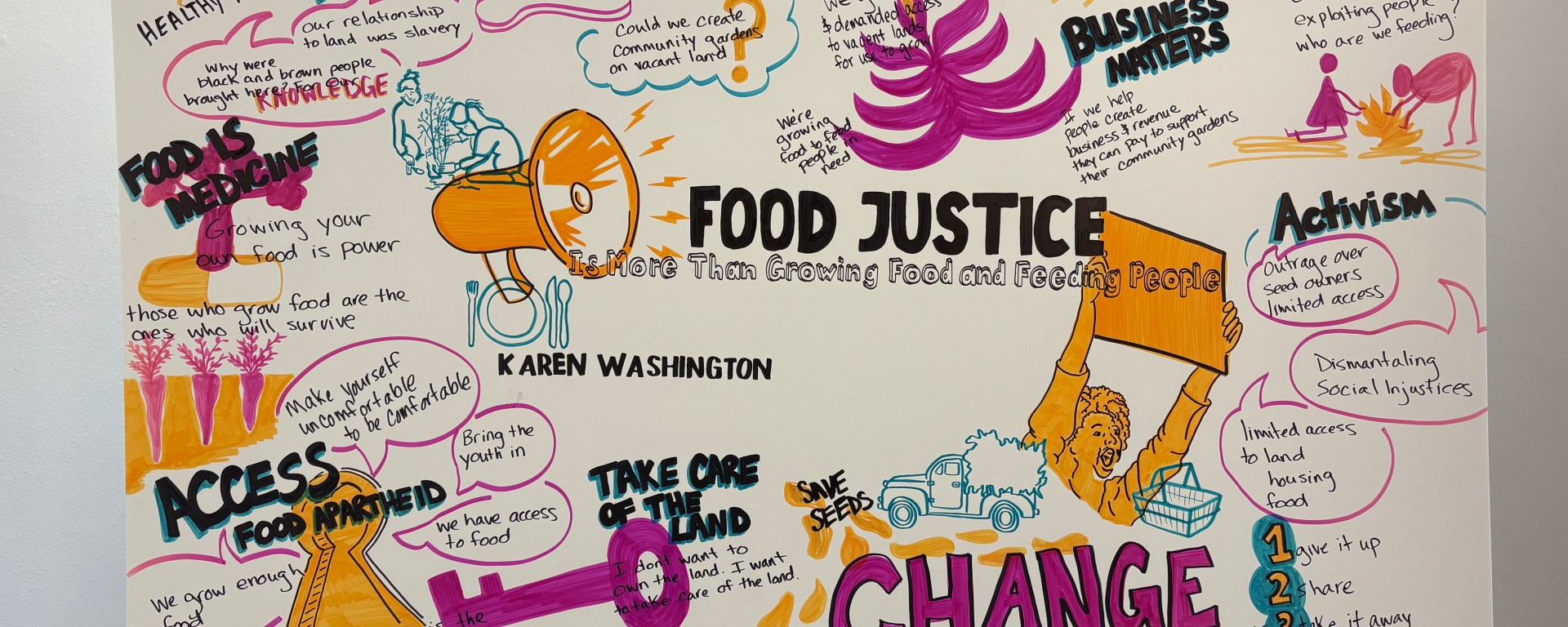
On a chilly October morning, food lovers fill the rows of tables throughout the Martha Eddy room in the Art and Home Center at the NYS Fairgrounds. As keynote speaker Robin Wall Kimmerer steps to the front, a hush falls over the crowd, and the Syracuse-Onondaga Food Systems Alliance’s (SOFSA) 3rd Annual Food Justice Gathering begins. The theme: interwoven. The land, the food, us.
Our connection with food today comes with a hashtag. From raw milk to RFK Jr.’s “war” on ultra-processed foods, the century-old “food-as-wellness” industry sparks a lot of opinions on how and what to eat. Still, few have focused on how our food systems contribute to climate change, and vice versa. According to a study by Our World in Data, our current agriculture production requires large amounts of fresh water, is responsible for around 25% of global greenhouse gas emission, and uses about half of the world’s habitable land. A study in Nature estimated crop production in the U.S. could drop by 50% by the end of the century, due to climate change.
Sustainable gastronomy, rooted in sustainable agriculture, has offered one potential solution. By using what’s available, the cuisine accounts for how the food gets to the plate: the origin of ingredients, the method of growing food, and the transportation to the markets before we eat it, according to the United Nations. In short, sustainable agriculture encourages “practices that take into account the health of the environment, as well as the health of the consumer, at a bare minimum,” explained Micah Orieta, the Food Systems and Network-Building Organizer at SOFSA. “That can look like using water differently, or using different inputs instead of harmful pesticides and herbicides.”
SOFSA encourages these practices by connecting different sectors of the food system like agriculture, food distribution, the Emergency Food Network, and community groups. Its current goal is helping promote and connect with the regional farmer’s market in Syracuse. “The regional market really helps to maintain the viability of the regional sustainable agriculture,” said Matthew Potteiger, Professor of Landscape Architecture at SUNY-ESF.
Potteiger co-founded Syracuse Grows, a grassroots urban food justice network, and has been involved with the Center for New Americans, a nonprofit that resettles refugees. In early 2020 he co-developed the CNY (Central New York) Food Plan, inspiring the idea for a food policy council–a council that shapes the use and availability of food in an area–that would become SOFSA.
Like Potteiger, Kimmerer called for more sustainable food systems, like food forests and foraging. Food forests involve planting a diverse range of food, mimicking successful ecological systems and the layers of edible plants in typical forests. These types of community gardens are self-sustaining because of their diversity. If one species falls to disease there are others to rely on.
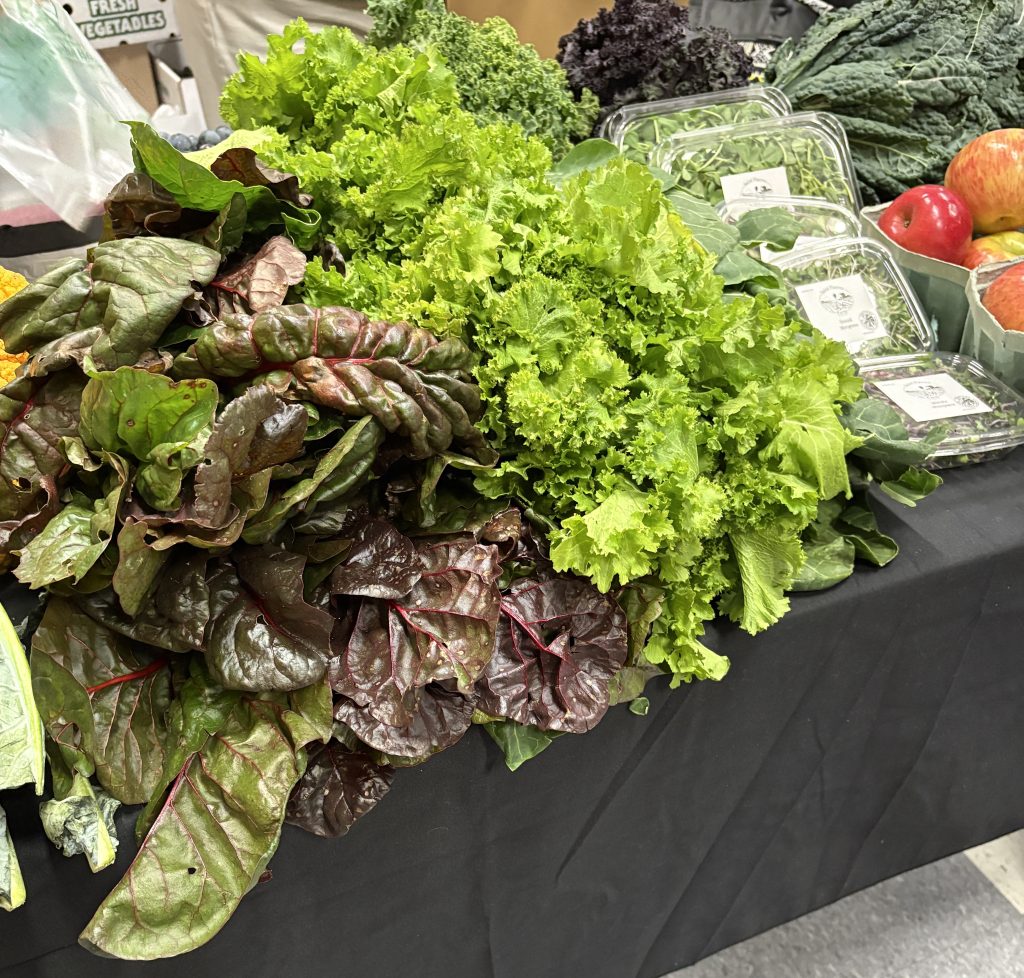
Foraging also works with local ecology, as people eat what grows around them naturally. “This is kind of like one end of the spectrum that there’s already food out there. We can really promote these ecologies and public access, ultimately free,” said Potteiger. Potteiger hopes to persuade the City of Syracuse to make foraging legal. The problem is our production and distribution systems, not that the food doesn’t exist, he added. If we split the world’s food production equally, each person would get 5,000 calories per day, according to data scientist Hannah Ritchie in her book Not the End of the World.
One restaurant using the local ecology is Blue Hill at Stone Barns. The menu is different every day, with ingredients supplied by local farmers based on what’s available for the season. A waiter takes note of preferences, curating the courses for each diner, so every ingredient is used and everyone is satisfied. “No two tables are really eating the same meal,” said co-founder David Barber.
Siblings David, Laureen and Chef Dan Barber acquired the restaurant from the Rockefeller family and opened in 2004 alongside the Stone Barns Center for Food and Agriculture in Westchester County, N.Y. When asked by the Rockefeller family to help preserve the property, the brothers decided to “justify the expenses of the renovation by doing things in agriculture and gastronomy that would be worthy of his generosity,” said Barber. “The mission of the place really became to talk about sustainable agriculture and renew interest in agriculture in that region.” The restaurant has earned a Michelin Green Star–for those who lead the industry in sustainability–with Chef Dan Barber’s work inspiring a new wave of chefs.
The restaurant supports the Stone Barns Center by buying food off that land. The nonprofit farm, education and research center uses community support agriculture to create a sustainable market with locally grown products. It started with the idea that growing locally and sustainably is better than large-scale industrial agriculture. But simply growing locally won’t solve the issue. Growing food based on demand, even if grown locally, isn’t sustainable. Instead, we should focus on local soil ecologies and weather patterns to guide us, Barber said.
The real question isn’t what we want to eat, but what we should be eating. Unlike other countries, the U.S. never had to adapt around what could be grown. We were blessed (or cursed) with abundant land. This led to a diet of abundance, producing and consuming much more than needed. “Those two ideas of diet change and regional eating and sustainable agriculture, in my opinion, are inextricably linked. To talk about one without the other is a little bit of wishful thinking,” said Barber.
The bottom line: sustainable agriculture and gastronomy would require a different diet. For Barber, a sustainable restaurant can’t buy food or create a menu based on what people want. That means no set menu. Instead, it works with local farmers to determine what food is available at the time, meaning there’s only so much of each ingredient, and so many types, depending on the season.
For example, in place of the Vermont maple syrup you might find in a diner just down the road, Stone Barns serves its own sorghum syrup. “So, if you care about those issues and you come to the Northeast on your vacation and you go to a pancake house, you should be eating Hudson Valley sorghum syrup,” joked Barber. “Would that work on a national level? Probably not.” Sorghum is more ecologically beneficial in the Hudson Valley because it isn’t imported, and can be grown sustainably in the region. But, this regional diversity means sorghum can’t be a national solution.
Currently, there is no existing sorghum market and farmers have used it as a “plow back in crop” –crops used to improve soil rather than produce food– to enrich soil. The center started experimenting with the crop, planting over a dozen varieties and narrowing it down to five or six that were regionally sustainable. Only two were useful in the kitchen at Blue Hill, showing the need for trial and error in gastronomy.
Crazy Daisies, a café located in Syracuse, N.Y., has its own method of sustainable gastronomy. The owners source most of their food on-site, harvesting from trees, fruit, shrubs, bushes, and greenhouses. Jennifer (Jenn) Cox started an agricultural business with greenhouses in 2007, which became a café in 2019. Blending agrotourism and the restaurant scene, Crazy Daisies provides seasonal and year-round menus. They rely heavily on their garden, growing as much as possible themselves, said Bella Matro, the Chief Operating Officer. When they run out, they turn to locally sourced farms or nearby nurseries, and only then head to a local supplier. This commitment to the local economy (instead of out-sourcing) helps the revenue stay in the community. “Our mission really is, we just like to say ‘live locally’ and we’re trying to stretch it in every way possible,” said Matro. “We are real people making real food.”
Their mission extends to personal well-being, where mindful consumption leads to better health. “We’re bridging the gap in educating the community about where your food comes from, where the ingredients are, and this didn’t come out of the freezer in a box. This was from a garden, or this was from a garden right down the road. Just knowing this was ethically sourced and it has all the good stuff in it, that you know, doesn’t hurt your body,” said Matro.
Ecological practices aren’t confined to restaurants, with plenty of ways to cook sustainable meals at home. Back at the fairgrounds, an audience surrounds the Wegmans Art and Home Center Demonstration Kitchen, eager to see what the chefs are cooking up. In the glow of the stage lights, Chefs Jed Locquiao and Steve Ali chop away, the sharp smell of onions making eyes water. Turmeric, tomatoes, squash and rice pop against the marble countertop. The chefs are making culturally significant dishes, Pinkabet and Jollof Rice, but with local ingredients.
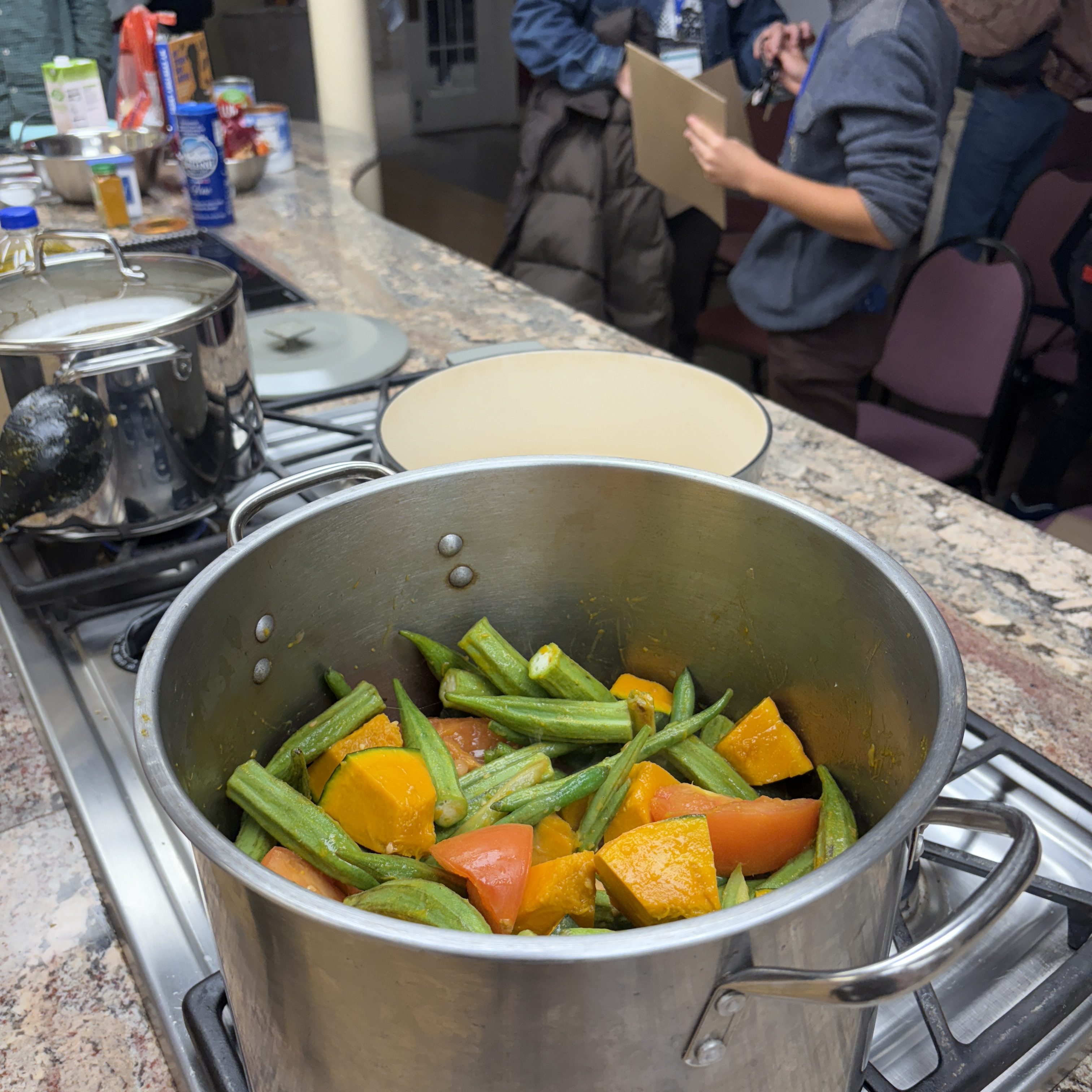
When Locquiao first moved to North Dakota, then Minnesota, years ago, he was shocked that people rarely cooked. “In those sorts of places, you don’t have an intimate relationship with what you’re preparing, which means that you can engage in those mindless, sort of extractive cooking practices,” he said. Locquiao sought out the people who make the produce, or those who know who do. “To sustain some sustainability in our culture, it’s to have relationships with people who are doing the work of trying to make it sustainable,” Locquiao said. It’s making a trip to your local market instead of a chain supermarket.
The focus on local change is an important one. Too big of a scale can lead to burnout. We aren’t waking up thinking we can change the world, because it’s too big and too complicated, so we won’t be successful, said Barber. A local mindset also supports accessibility and affordability. Focusing on local economies promotes a positive feedback cycle, where resources and money go back into the community. It also shifts to using what we have, instead of demanding what we don’t. A first step would be supporting local farmers on what they can and should be growing, said Barber. Wheat, like sorghum, is largely unsustainable. Farmers plant “plow back in crops” and attribute the time and money it takes to care for them to the cost of growing wheat. Instead, Barber suggests buying the whole farm, like Blue Hill at Stone Barns and other community-based farms do. Purchasing everything that’s grown for a season means farmers aren’t wasting crops, and buyers get more bang for their buck.
Supporting this system requires creating a space for new crop purchasing markets, which historically haven’t been too popular. That’s where organizations like SOFSA come in. “Right now, there’s… monocultures, and ‘big ag’ is incentivized in certain ways, and it’s really hard to compete with operations on that scale if you’re just kind of depending on market influences, aka like the consumer,” said Orieta. One possible avenue is through schools, with SOFSA working alongside CCE and different school districts to make it easier for them to buy from smaller-scale farmers. The barriers are current infrastructure and bureaucracy, which SOFSA hopes to lower by connecting with distributors and diverse stakeholders. Other solutions involve public investment at a government level with allocation of grants and subsidies, so sustainable agriculture can compete. Disincentives and fines for not taking sustainable measures are another possibility, although it could potentially damage relationships, said Orieta. Instead, organizations like New American or SOFSA can support businesses by connecting them with farmers and suppliers.
Many of these sustainable options are pricey, inaccessible to a general population. Blue Hill, increasingly popular among celebrities and fine diners, is one example: It costs $398 per guest for a meal, and $448 to add a tour of the Stone Barns Center. Crazy Daisies costs significantly less: $14 for a cheese pizza ($19 gluten-free). Still too expensive for a region with multiple counties in the Top 10 for food insecurity nationally, according to Syracuse.com. Organizations that do provide lower cost options have faced severe budget cuts and frozen funds under the Trump administration (like “hitting a wall,” said Potteiger), which will soon end multiple programs supporting these organizations. “The commodification of food just strips it of all its other values,” said Potteiger.
This doesn’t have to be the case. Barber’s work looks toward giving the communities power to grow their own foods. SOFSA emphasizes food and community connection. “It doesn’t have to be a niche thing,” said Potteiger.
As the Food Justice gathering winds down, Sofia Gutierrez leads one of the last sessions: using art to connect food and wellness. Paper, scissors, colored pencils, markers, and stickers sprawl across the long clothed table as people draw anything from turnips to dragons hoarding wealth (a comment on capitalism) in their mini booklets. There’s a grieving over societal expectations: alcohol on nights out, sugary cereals for breakfast, plastic packaging that replaces fresh fruits and vegetables. “Our foods have been made into conveniences. That hurts our bodies. That hurts our spirits,” said Gutierrez.
At the end of the day, taste drives our connection to what and how we eat. After all, who would want to eat food that tastes, literally, like dirt? The job of the sustainable gastronomer is to make these new foods taste good, and a new market to sell them. “We need to imagine that it’s possible for things to change, and be hopeful and curious about how to do that,” said Orieta. “Advocacy, engagement and contribution will be our best hopes for the future.”
 Green Horizon